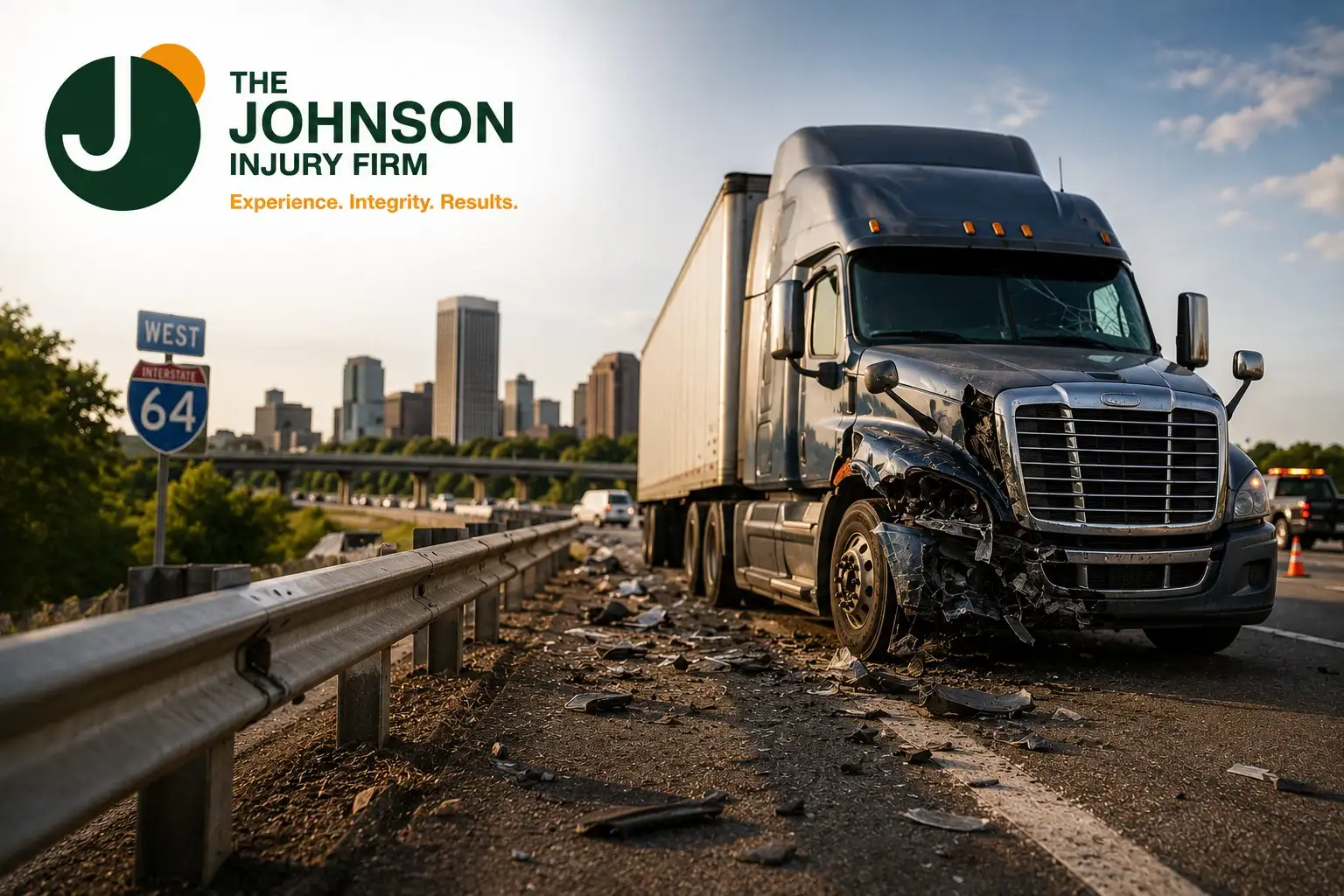
When a commercial truck causes a crash on I-64 in Richmond, the driver is not always the only party responsible. Federal motor carrier regulations impose independent legal duties on trucking companies. If the carrier hired an unqualified driver, failed to maintain the vehicle, violated hours-of-service rules, or pressured drivers to meet unsafe delivery schedules, the company itself may be liable for your injuries.
Virginia law also allows injured victims to pursue the carrier directly under theories of negligent entrustment and respondeat superior. Identifying all liable parties is one of the most important steps in any serious truck accident case, and it requires an investigation that goes well beyond the police report.
About The Johnson Injury Firm
The Johnson Injury Firm represents seriously injured people in Richmond and throughout Central Virginia. Our attorneys handle complex personal injury cases, including commercial truck accidents involving multiple liable parties.
We investigate these cases aggressively, we work with qualified experts when the evidence demands it, and we take cases to trial when insurance companies refuse to pay fair value. We work directly with our clients. Every case is handled by an attorney, not a case manager.
Why I-64 Produces Serious Truck Crashes
Interstate 64 runs directly through Richmond, connecting the Shenandoah Valley to Hampton Roads and carrying heavy commercial traffic through one of the busiest corridors in the mid-Atlantic region. The stretch through Richmond includes tight interchange configurations at I-95, elevated sections near Shockoe Bottom, and significant grade changes as it heads west toward Charlottesville.
Commercial trucks traveling this route face congestion, construction zones, and merge patterns that require precise vehicle control. A fully loaded 18-wheeler can weigh up to 80,000 pounds. At highway speed, the stopping distance for that vehicle is dramatically longer than for a passenger car. When something goes wrong on I-64, the results are often catastrophic.
The Difference Between Driver Liability and Carrier Liability
Most people assume that when a truck driver causes a crash, the driver is the responsible party. That assumption is legally incomplete.
A trucking company is a regulated business operating under the authority of the Federal Motor Carrier Safety Administration (FMCSA). That agency imposes duties on carriers that are entirely separate from anything the driver does behind the wheel.
What Carriers Are Legally Required to Do
Under FMCSA regulations, a motor carrier must:
- Verify that every driver holds a valid commercial driver’s license for the class of vehicle operated
- Conduct pre-employment drug and alcohol screening and maintain random testing programs
- Review each driver’s safety performance history before hiring
- Ensure the vehicle is inspected and maintained according to federal safety standards
- Monitor driver hours and enforce hours-of-service limits to prevent fatigued driving
- Retain records of all inspections, driver logs, and maintenance activity
When a carrier fails to meet any of these obligations and that failure contributes to a crash, the company bears direct responsibility. This is true even if the driver was also negligent.
Three Theories of Carrier Liability in Virginia Truck Cases
Respondeat Superior
Under this doctrine, an employer is legally responsible for the negligent acts of an employee committed within the scope of employment. If the driver was operating under the carrier’s authority at the time of the crash, the company is vicariously liable. This applies regardless of whether the carrier was independently negligent.
Negligent Hiring and Retention
A carrier that hires a driver with a disqualifying history of crashes, license suspensions, or failed drug tests can be held independently liable for negligent hiring. The same applies if the company retained a driver after discovering warning signs and failed to act. Virginia courts have recognized this theory in cases involving foreseeable harm.
Negligent Entrustment
This theory applies when a carrier entrusts a commercial vehicle to a driver whom the company knew or should have known was unfit to operate it safely. Evidence of prior violations, incomplete training records, or waivers of disqualifying conditions can all support this claim.
Why Carriers Are Often the More Important Defendant
From a practical standpoint, pursuing the career rather than only the driver matters for several reasons. Commercial carriers are required under federal law to carry substantial liability insurance, often $750,000 or more for standard freight, and up to $5,000,000 for certain hazardous material loads. An individual driver rarely has assets or insurance sufficient to compensate for serious injuries.
Beyond insurance, carriers have institutional knowledge and records that are critical to the case. Those records have a limited lifespan.
| Record Type | Federal Retention Requirement |
| Driver qualification file | Duration of employment plus 3 years |
| Hours-of-service logs | 6 months |
| Vehicle inspection reports | 12 months |
| Drug and alcohol test results | 1 to 5 years depending on result |
| Accident register | 3 years |
These records can and will be destroyed once the retention period expires. In cases involving serious injuries, our attorneys move quickly to send spoliation letters demanding that all relevant records be preserved. Waiting weeks or months to take that step can permanently eliminate evidence.
Independent Contractors and Leased Operators: A Common Complication
Many trucking companies use independent contractors rather than direct employees. Carriers often argue this arrangement shields them from liability. Federal regulations close that loophole in many situations.
Under 49 C.F.R. Part 376, when a carrier leases a truck from an owner-operator and places that vehicle under its operating authority, the carrier assumes responsibility for the vehicle and its operation during the lease period. Courts in Virginia have applied this standard to hold carriers liable even when the driver held an independent contractor status.
If the truck involved in your crash displayed the carrier’s DOT number at the time of the accident, that is a significant factor in establishing the company’s legal responsibility.
What a Thorough Investigation Looks Like
A truck accident case on I-64 requires more than reviewing the police report. Our attorneys work to obtain the electronic logging device data from the truck, which records speed, braking, hours of operation, and engine activity. We request the carrier’s driver qualification file, maintenance records, and any internal communications related to the driver or route.
We also examine whether any third-party brokers or shippers played a role in creating unsafe conditions. In some I-64 corridor cases, the party that hired the carrier may share liability if they selected a company with known safety deficiencies or imposed scheduling demands that pressured drivers to violate hours-of-service rules.
Talk to a Truck Accident Lawyer in Richmond
Truck accident cases move fast. Evidence is time-sensitive and carriers have legal teams working from the moment a crash is reported. If you or someone you love was injured in a commercial truck crash on I-64 or anywhere in the Richmond area, you need an attorney who understands how these cases work at every level.
Our team at The Johnson Injury Firm is ready to evaluate your case. Speak with a personal injury attorney in Richmond who will investigate every liable party, not just the driver, and fight for full and fair compensation. Consultations are free and we charge no fee unless we recover for you.
Frequently Asked Questions
Can I Sue the Trucking Company Directly After an I-64 Crash?
Yes. Under federal motor carrier regulations and Virginia personal injury law, injured victims can bring claims directly against the carrier. You do not have to limit your claim to the driver. If the carrier violated FMCSA regulations, failed to properly vet or supervise the driver, or failed to maintain the vehicle, those failures are independent grounds for liability.
How Is a Truck Accident Case Different From a Regular Car Accident Case?
Commercial truck accidents involve federal regulations, multiple potentially liable parties, and time-sensitive evidence that does not exist in a standard car crash case. The carrier’s electronic logging data, driver qualification file, and maintenance records must be obtained quickly before they are overwritten or destroyed. These cases typically require expert witnesses to explain violations of federal safety standards to a jury.
What If the Truck Driver Was an Independent Contractor?
The independent contractor label does not automatically protect the carrier from liability. Under federal leasing regulations, when a carrier places a vehicle under its operating authority, it assumes legal responsibility for that vehicle’s operation during the lease. Virginia courts evaluate the actual nature of the relationship, not just how the parties labeled it in a contract.
How Long Do I Have to File a Truck Accident Lawsuit in Virginia?
Virginia Code Section 8.01-243 gives injured victims two years from the date of the accident to file a personal injury lawsuit. However, the investigation must begin well before that deadline. Electronic logging data may be overwritten in a matter of weeks. Preservation demands must be sent immediately after an accident. Waiting until near the deadline significantly weakens the case.
What Compensation Can I Recover After a Commercial Truck Accident?
Virginia law allows injured victims to recover economic damages, including all medical expenses, future treatment costs, lost wages, and diminished earning capacity. Non-economic damages for pain, suffering, and permanent impairment are also recoverable. In cases where the carrier acted with reckless disregard for public safety, punitive damages may be available. The specific value of your case depends on the severity of your injuries and the strength of the evidence.
What Should I Do Immediately After a Truck Accident on I-64?
Seek medical attention first, even if you believe your injuries are minor. Call law enforcement and ensure a crash report is filed. Do not speak with the carrier’s insurance representatives before consulting an attorney. If you are physically able, photograph the scene, the truck’s DOT number and license plate, and any visible road conditions or damage. Contact an attorney as soon as possible so that preservation demands can be sent before critical evidence disappears.