If you developed silicosis after cutting, grinding, or polishing engineered stone or other silica products, you may have a lawsuit against the companies that made or sold the material, separate from workers’ compensation. Virginia deadlines can expire within two years of diagnosis, and contributory negligence rules apply. A free case review can tell you which claims are still open.
Reviewed by J. Penn Crawford, Partner, The Johnson Injury Firm. Licensed in Virginia since 2002 and handling personal injury cases in Richmond and across Virginia. Last legally reviewed October 2026.
A silicosis lawsuit lets a worker harmed by silica dust seek compensation from the companies that manufactured, imported, or distributed the dangerous material. In Virginia, these claims usually target engineered stone makers and suppliers, because the law generally limits what you can recover from your own employer to workers’ compensation benefits. The Johnson Injury Firm helps Richmond-area workers and families sort out both paths before a deadline passes.
What Is Silicosis, and Why Are Countertop Workers Getting Sick?
Silicosis is an incurable lung disease caused by breathing respirable crystalline silica, the fine dust released when workers cut, grind, or polish stone, concrete, and similar materials. The particles scar lung tissue, and the scarring can worsen even after exposure stops. Silica exposure is also linked to lung cancer, chronic obstructive pulmonary disease, and kidney disease.
Engineered stone, often sold as quartz, has driven a new wave of cases. These slabs are made by binding crushed quartz with resin, creating a material with much higher silica content than most natural stone. Researchers estimate that about 100,000 stone fabricators in the United States are at potential risk.
How Much Silica Is in Common Countertop Materials
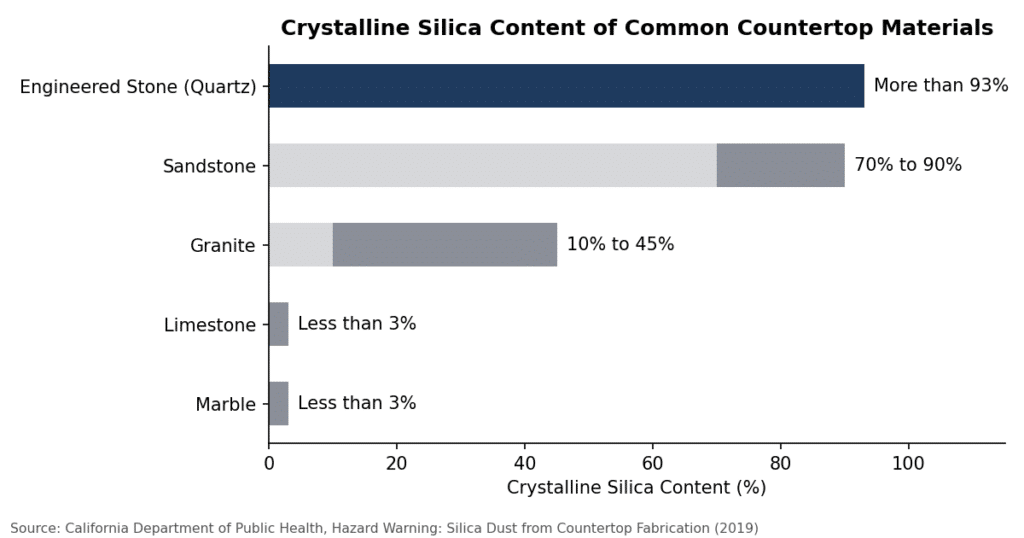
The California Department of Public Health reports that engineered stone contains more than 93 percent crystalline silica, compared with 10 to 45 percent for granite and less than 3 percent for marble. OSHA limits worker exposure to 50 micrograms of respirable silica per cubic meter of air, averaged over an eight-hour shift.
Why Silicosis Is Often Diagnosed Late
Early symptoms include a lingering cough, shortness of breath, fatigue, and chest pain. Doctors frequently mistake them for pneumonia or tuberculosis. In a 2023 JAMA Internal Medicine study of 52 California countertop workers with engineered stone silicosis, the median age was 45, more than half were diagnosed late, and nearly one in five died.
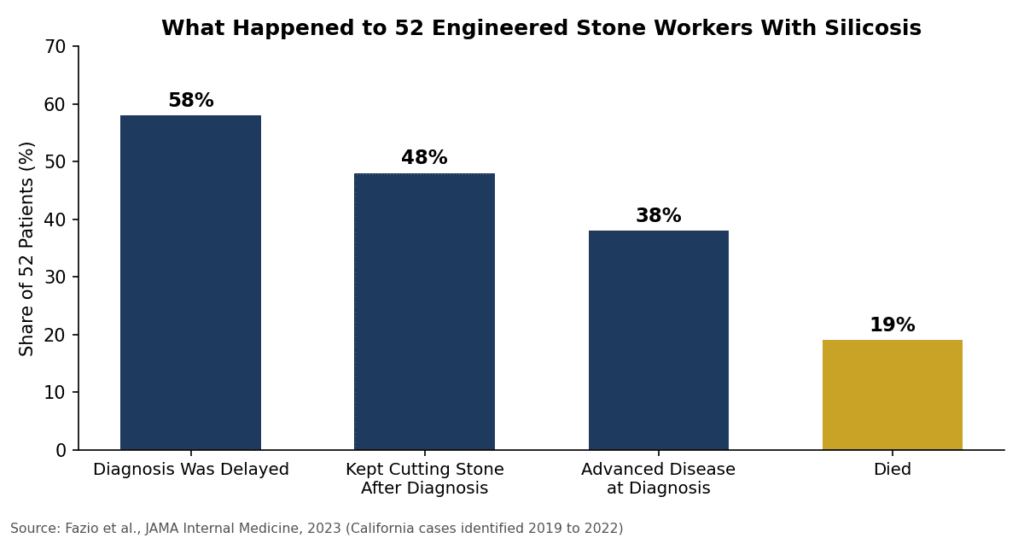
That delay matters legally. Virginia deadlines depend on when a diagnosis is first communicated to you, so a misdiagnosis can quietly affect how much time you have.
Can You File a Silicosis Lawsuit in Virginia?
Yes, but usually not against your employer. Under Virginia Code § 65.2-307, workers’ compensation is generally the exclusive remedy against an employer for a work-related occupational disease.
Virginia Code § 65.2-309 preserves your right to pursue other parties whose conduct caused the harm, such as the companies that manufactured or distributed the slabs you cut. Your employer’s insurer may hold a lien on part of that recovery, which needs to be accounted for at settlement.
Workers’ Compensation vs. a Silicosis Lawsuit
| Factor | Workers’ Compensation | Third-Party Silicosis Lawsuit |
| Who pays | Your employer’s insurer | Manufacturers, importers, distributors, and suppliers |
| Must you prove fault? | No | Yes, through negligence or breach of warranty |
| Pain and suffering | Not available | Available |
| Punitive damages | Not available | Possible in limited cases, capped at $350,000 in Virginia |
| Filing deadline | 2 years from diagnosis or 5 years from last exposure, whichever comes first | Generally 2 years; a latent injury rule may change when the clock starts |
Who Can Be Held Responsible
Potential defendants include engineered stone manufacturers, slab importers, and the distributors that sold slabs to your shop. Claims typically focus on whether these companies knew how dangerous the dust was, whether they gave fabricators adequate warnings, and whether a safer design was available. Identifying every brand you cut is often the hardest part of building the case.
How Virginia Product Liability Law Affects Your Claim
Virginia is one of only a handful of states that does not recognize strict liability in tort for defective products. That means you generally must prove negligence or breach of warranty. Virginia also follows contributory negligence, which allows a defendant in a negligence claim to argue that any fault on your part bars recovery.
Manufacturers commonly point to missing respirators or dry cutting, so documenting the safety conditions in each shop is essential. Warranty claims are treated differently, which is one reason the theories in your complaint matter.
Virginia Silicosis Deadlines You Cannot Afford to Miss
| Claim or Step | Deadline | Virginia Law |
| Notice of occupational disease to employer | 60 days after diagnosis is communicated | Va. Code § 65.2-405 |
| Workers’ compensation claim | 2 years from diagnosis or 5 years from last injurious exposure, whichever comes first | Va. Code § 65.2-406(A)(7) |
| Personal injury lawsuit | 2 years | Va. Code § 8.01-243(A) |
| Latent injury accrual | Clock may start when you knew or should have known of the injury and its cause | Va. Code § 8.01-249(4a) |
| Lawsuit after a death | No later than 2 years after death | Va. Code § 8.01-249(4a) |
Virginia courts enforce these limits strictly. In Miller v. Locher Silica Corp. (1991), the Virginia Court of Appeals upheld the dismissal of a silicosis compensation claim because it was not filed within five years of the worker’s last injurious exposure.
Silicosis Lawsuit Settlements and Verdicts So Far
No reliable average silicosis lawsuit settlement exists, and results so far vary widely. In August 2024, a Los Angeles County jury returned a $52.4 million verdict for Gustavo Reyes Gonzalez, a 34-year-old fabricator who needed a double lung transplant after 15 years of cutting engineered stone.
The jury assigned 15 percent of the fault to Caesarstone USA, 10 percent to Cambria, and 2.5 percent to Color Marble, with 70 percent assigned to others, including his employers. Caesarstone and Cambria have appealed.
Other trials have gone differently. A California jury in May 2025 found that the slabs at issue were not defectively designed, while a Colorado jury assigned Cambria 32 percent of the fault in another case. Industry press has reported that California silicosis recoveries have topped $200 million. These cases arose under California and Colorado law, which differ from Virginia law in important ways.
“Most people we talk to were told for months that they had pneumonia or asthma. By the time someone says the word silicosis, the clock is already running. The first thing we do is pin down the exact date a doctor gave that diagnosis, because in Virginia that date can decide whether the case survives.” J. Penn Crawford, Partner
Not sure which deadline applies to you? Call 804-JUSTICE for a free review of your dates. Partner J. Penn Crawford has been honored by both Best Lawyers in America and Virginia Business Legal Elite for five consecutive years.
Evidence That Strengthens a Silicosis Claim
The strongest cases start with the medical record, including chest imaging, lung function tests, any biopsy, and the note showing when silicosis was first diagnosed. Next comes a detailed work history listing every shop, your dates there, and the tasks you performed. Brand names matter, so invoices, slab labels, photos of stamped slab edges, and safety data sheets can help identify defendants. Coworker statements and any OSHA inspection records can show how dust was controlled, or not controlled, at each job.
Common Concerns About Filing a Silicosis Lawsuit
“I used water and wore a mask.” So did Mr. Reyes Gonzalez, according to his own account, and he still developed severe silicosis. Safety steps don’t end a claim, but you must document them carefully because of Virginia’s contributory negligence rule.
“I still work in the industry.” A third-party lawsuit is filed against manufacturers and suppliers, not your employer. Virginia Code § 65.2-308 also prohibits firing an employee for filing a workers’ compensation claim.
“I cannot afford a lawyer.” The Johnson Injury Firm offers free consultations and charges no fee unless we recover compensation for you.
Frequently Asked Questions About Silicosis Lawsuits
Can you sue for silicosis?
Yes. In Virginia, you generally cannot sue your employer, but you can pursue a product liability lawsuit against the companies that manufactured, imported, or distributed the silica products that caused your disease, while also seeking workers’ compensation.
What is the typical settlement amount for a silicosis lawsuit?
There is no typical amount. Publicly reported results range from defense verdicts to a $52.4 million jury award, and value depends on disease severity, age, lost earnings, transplant needs, and which companies can be held responsible.
How much compensation can you get for silicosis?
A lawsuit can seek medical expenses, future care including transplant costs, lost wages and earning capacity, and pain and suffering. Punitive damages are possible in limited cases and are capped at $350,000 in Virginia.
How long do I have to file a silicosis lawsuit in Virginia?
Most personal injury lawsuits must be filed within two years. For latent injuries, the clock may start when you knew or should have known of the injury and its cause. Workers’ compensation has its own, shorter outer limit.
Do I need to have worked with engineered stone to have a claim?
No. Granite, sandstone, and other silica-containing materials can also cause silicosis. Engineered stone cases have drawn attention because the material contains so much more silica.
Can my family file if a loved one died from silicosis?
Yes. Families may be able to bring a wrongful death lawsuit, which in a latent injury case generally must be filed no later than two years after death. Workers’ compensation death benefits claims have separate timing rules.
What Happens When You Call The Johnson Injury Firm
A member of our Richmond team answers and asks a few questions about your diagnosis, the shops where you worked, and the materials you cut. We will want to know the date a doctor first told you it was silicosis. The call is free, and there is no obligation. You will leave knowing which Virginia deadlines likely apply and whether a third-party claim may be available.
Talk to a Virginia Silicosis Lawyer Today
Silicosis deadlines in Virginia can close before many workers realize they have a case. Partner J. Penn Crawford has been honored by Best Lawyers in America and Virginia Business Legal Elite for five consecutive years, and our firm has represented injured Virginians for decades. Call 804-JUSTICE or (804) 315-2675, or visit our office at 5501 Staples Mill Road in Richmond. Consultations are free, and you pay no fee unless we win.