If you’ve been injured in Virginia and aren’t sure what to do next, this book is for you. Injured in Virginia: What You Need to Know About Personal Injury Claims walks you through the claim resolution process step by step — from the first hours after an injury-accident through settlement negotiations and beyond.
We explain how the law works, how insurance companies work, and how to avoid the common (and costly!) mistakes that can crater your claim.
No Fee Unless We Win · 804-JUSTICE · Richmond, Virginia
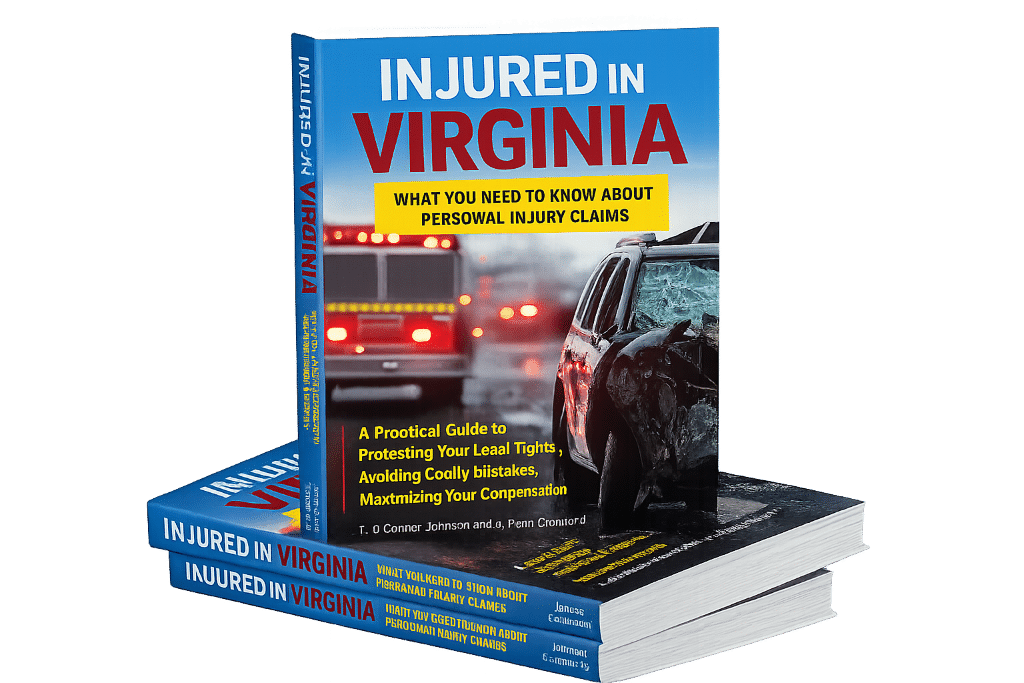
Injured in Virginia: What You Need to Know About Personal Injury Claims
A Practical Guide to Protecting Your Legal Rights, Avoiding Costly Mistakes, and Maximizing Your Compensation
OUR MISSION
Why We Wrote This Book
We wrote this book for one simple reason: To arm you with the knowledge you need to get the compensation you deserve after an injury-accident.
Virginia law is uniquely harsh toward injury victims. If the insurance company can argue that you were even 1% at fault, you can lose your entire claim. Insurance adjusters know this, and they use it to their advantage from their very first phone call with you.
In short: The system is stacked against you. With this book, we aim to change that.
Injured in Virginia: What You Need to Know is a practical, start-to-finish guide to protecting your rights, avoiding common traps, and maximizing the value of your personal injury claim.
INSIDE THE BOOK
What You Will Learn
Injured in Virginia: What You Need to Know is packed with practical, Virginia-specific information you need to build a strong personal injury claim, from the first hours after an accident to settlement negotiations with the claims adjuster.
3 critical mistakes people make in the first 24–72 hours after an injury-accident and how to avoid them
3 ways social media can crater your claim if you’re not careful
4 legal elements you must prove to make out a valid personal injury claim in Virginia
4 factors that consistently increase the value of a personal injury claim
4 factors that tend to lower the value of a personal injury claim
4 reasons soft-tissue injuries are always undervalued by the insurance company (and, often, by jurors)
5 tactics insurance companies use to delay, deny, or devalue injury claims
6 red flags that signal it’s time to call a personal injury lawyer
How 11 different accident scenarios (from auto accidents to bicycle-car collisions to stairway falls to inadequate security) present unique challenges and hurdles to fair compensation
AND MORE!
VIDEO LIBRARY
Watch & Learn
COMMON QUESTIONS
Frequently Asked Questions
You’ve got questions. This book has answers.
We wrote Injured in Virginia: What You Need to Know to address your most pressing questions and help you avoid costly mistakes that could hurt your personal injury case. Read on to see answers pulled straight from the book.
I. Do I Have a Case?
Do I have a personal injury case or was this accident just really bad luck?
A personal injury case is a legal claim for compensation when someone else’s carelessness causes you harm. The question isn’t whether you were unlucky; it’s whether someone else failed to act with reasonable care. Did a driver run a red light? Did a property owner ignore a known hazard? Did someone break a safety rule? If you can prove that (1) another person’s carelessness (or, in legal terms, “negligence”) caused your injuries, and (2) you suffered real damage – medical bills, lost wages, ongoing pain, or lasting limitations – then you may have a valid personal injury claim.
Do I still have a legal claim even if the accident happened months ago?
Possibly, but delay creates risk. Virginia’s “statute of limitations” – the legal deadline for filing a lawsuit – is two years from the date of injury. If you miss that deadline, you lose your right to seek compensation. But even before that deadline arrives, delays weaken your evidence, raise credibility questions, and give the insurance company leverage it otherwise wouldn’t have. So, the sooner you take action and the sooner you get legal advice, the stronger your claim will be.
If I was partly at fault, do I still have a personal injury case?
Maybe, but Virginia law favors the insurance companies and is tough on injury victims.
Most states follow what’s called the “comparative negligence” rule. In those states, a person can recover compensation even if they were partly at fault for the accident, but their compensation is reduced according to their share of fault. So, if someone is 20% at fault, then whatever compensation they might be entitled to would be reduced by 20%.
Virginia is different.
Virginia is one of only a handful of states that still follows the “contributory negligence” rule. In plain terms, this means that if your conduct contributed to the accident – even if you were only 1% at fault – you can be legally barred from recovering any compensation at all. It doesn’t matter how badly you were hurt or how careless the other person was. If the insurance company can make a plausible argument that you were careless too, they will rely on the contributory negligence rule to try to wipe out your entire claim.
It’s harsh. It’s an outlier. But it’s the law here, and insurance companies know exactly how to exploit it.
II. What Is My Case Worth?
How do you put a dollar value on a personal injury claim?
When we consider the value of a personal injury case, we typically start with what we call the “floor” of the case, which is the total cost of your medical bills and any lost wages from time you missed at work. From there, the value can go up, depending on how long you’ve had to deal with the effects of the injury. We also consider non-economic factors like pain, suffering, inconvenience, and whether there’s any lasting impact on your life. If you’ve suffered a permanent injury, that significantly increases the value of your case. Even if the injury isn’t permanent, we focus on how it affects you and your daily life.
So, let’s say you injure your left hand. If you’re a right-handed baseball pitcher, that might not impact you all that much. But if you’re a left-handed pitcher, that same injury could be career-altering. It’s not just about the injury itself; it’s about how that injury affects you. That’s a big part of how we evaluate a case and determine what fair compensation looks like.
When do you know how much a case is worth?
That can take some time because injuries often don’t fully reveal themselves right away. Sometimes people need surgery down the road, or they continue treatment longer than expected. They might even get a permanency or impairment rating later on, which can significantly impact the value of the case.
So, early on, we just don’t have all the information. It’s only after we see the full scope of a client’s medical treatment and understand the long-term impact of the accident that we can really talk to the insurance company about fair compensation.
What factors might make a personal injury case stronger or weaker?
In Virginia, one of the biggest factors is liability – that is, who was at fault. That’s because Virginia is a contributory negligence state, which means that if you were even partially at fault for the accident, if your carelessness contributed to the collision in any way, then you’re not entitled to any compensation. So, strong evidence that the other party was entirely at fault is critical.
Beyond that, the extent of your injuries is a major factor. It’s pretty straightforward: The more serious the injury, the stronger the case is likely to be (and the more it is likely to be worth in terms of monetary compensation). If your injuries are permanent or you have a significant amount of medical bills, those things strengthen your case. The way the injury affects your life also can significantly strengthen or weaken your case.
III. Common Mistakes that Can Hurt Your Case
What are some common mistakes a person might make that would hurt their personal injury case without them even realizing it?
Some of the most common mistakes we see are:
• Delaying medical treatment and not treating consistently; • Talking to an insurance adjuster without legal representation; • Posting on social media about the injury-accident; and • Waiting too long to hire an attorney, or not hiring one at all.
Why is it a mistake to talk to the other party's insurance company?
Most people don’t understand how insurance companies work or the role the adjuster plays. The claims adjuster’s job is essentially to undermine your case. They are not on your side.
Plus, most people have no idea what they’re entitled to. They might think it’s just medical bills and nothing more, and adjusters take advantage of that. If you don’t know that you’re also entitled to compensation for lost wages, pain and suffering, and inconvenience, the adjuster isn’t going to volunteer that information. You could end up settling for far less than your claim is worth.
Why is it a mistake to wait to hire an attorney (or not hire one at all)?
Trying to deal with the insurance company on your own is probably the biggest mistake people make. It’s a complicated process, and if you’re not familiar with the rules, it’s easy to make a costly misstep without even realizing it.
Virginia insurers are aggressive. They know the law tilts in their favor; they know most people don’t fully understand their rights; and they will take advantage of that. They will call soon after the accident, push you to give a recorded statement, and dangle a quick settlement check before you’ve even finished your medical treatment. Why? Because they want you to take the money and move on before you realize how much your claim is actually worth.
An experienced attorney knows the law and understands the tactics that insurance companies use to minimize their payouts. Once you have a lawyer on your side, the adjuster’s ability to play those games is significantly reduced. That’s a big part of the reason you hire an attorney. We know more about the law and the legal process and the way insurance companies work than you do because we deal with these issues every day, and we can advise you based on that experience.
Why is it a mistake to accept an early settlement offer?
Early settlement offers are designed to close your case quickly, before you understand how serious your injuries are or what your claim is actually worth.
Adjusters push for fast settlements because they know your injuries may not be fully known yet. Some injuries don’t reveal themselves for days or weeks, and some worsen over time. If you settle before your treatment is complete, you’re betting that you won’t need surgery, ongoing care, or time off work down the road.
And here’s the critical part: When you accept a settlement and sign a release, you give up your right to future compensation, even if your condition worsens dramatically. You only get one settlement. You can’t come back later to ask for more money if complications arise or you need additional treatment. That’s why timing matters. Early settlement offers aren’t based on fairness; they’re based on what the insurance company hopes it can get away with paying right now, before you realize you’re leaving money on the table.
Why is it a mistake to post about the injury-accident on social media?
You should assume that the insurance company and the defense lawyers are monitoring your social media activity, and anything you post might be used against you in your personal injury case. So, we tell our clients: Good, bad, or indifferent, do not post anything about the accident, your injuries, your recovery, or anything related to your personal injury claim. Even something that seems harmless can be twisted or taken out of context and used against you, especially in Virginia, where contributory negligence means that any fault on your part could wipe out your entire claim.
IV. Timing, Evidence and Documentation
How long does it take to resolve a typical personal injury claim?
The short answer here is: It depends. The timing of your case is going to depend on what your injury is, how long your treatment lasts, and who we’re dealing with on the other side. It also depends on whether you’re willing to take the case all the way to court. Ultimately, every case is different. A small case might be resolved in six months or maybe even less. A really complex case, on the other hand, could take two to three years.
What kind of documentation or records should I keep after my accident?
We’d like to see any photos or videos you have, as well as any police report or incident report or exchange-of-information form from the scene. It’s also a good idea to keep track of where you’ve gone for treatment. That might seem obvious at the time, but by the end of the case, you’d be surprised how easy it is to forget some of the details.
It’s also helpful to keep an injury journal or pain diary. Personal injury cases often take time to resolve, and as weeks or months pass, it becomes harder to remember the day-to-day impact an injury had on your life. Regular notes about your symptoms, pain levels, missed activities, sleep problems, and how the injury affects your work or daily routines can help preserve those details. Because the full impact of your injuries doesn’t always show up clearly in your medical records, a journal can provide valuable evidence of the harm you have suffered.
V. Medical Care
I can't afford medical care right now. What should I do?
Talk to a personal injury lawyer. We know doctors, physical therapists, and other medical providers who will treat you without requiring upfront payment or health insurance. They’ll agree to hold their bill until your case is resolved, and then we can make sure they get paid from the settlement.
In addition, you can apply for benefits, like Medicaid, that will help cover the cost of necessary treatment while your case is pending.
Should I see a doctor even if I don't feel seriously injured at the scene?
Yes. Many injuries don’t fully reveal themselves immediately. Adrenaline and shock can mask pain; symptoms from soft-tissue injuries often appear hours or days later. Seeking medical care promptly protects your health by identifying injuries early and starting appropriate treatment.
From a legal perspective, early medical care creates a clear record linking your injuries to the accident. Insurance companies routinely argue that delayed treatment means the injury wasn’t serious or wasn’t caused by the accident. Prompt medical documentation is a key foundational element of a successful injury claim.
How can delays, gaps in treatment, or missed appointments hurt my case?
Delays or gaps in treatment give insurance companies an opening to challenge your claim. They may argue that: (1) you weren’t really injured; (2) you recovered quickly; or (3) something else caused your condition. Missed appointments can be framed as proof you weren’t taking your recovery seriously.
Insurance companies scrutinize medical records closely when deciding how much your claim is worth. Consistency in treatment strengthens your credibility and shows your injuries required ongoing care. Unexplained gaps in treatment, on the other hand, can significantly reduce the value of your claim.
Should I continue seeing my doctor even if my symptoms seem to be improving?
Yes. You should continue treatment until your doctor formally discharges you from care. Improvement doesn’t always mean full recovery, and stopping treatment too soon can lead to setbacks or unresolved injuries. Continuing care ensures your recovery is properly monitored and documented. Moreover, from a legal standpoint, ongoing treatment shows that your injuries were real and serious enough to require sustained medical attention.
VI. Dealing with the Insurance Company
Why do insurance companies reach out so quickly after an accident?
Insurance companies move fast because early contact gives them an advantage. Before you fully understand your injuries or your rights, an adjuster may call to get a statement, shape the narrative about what happened, or push for a quick settlement. Their goal isn’t to help you; it’s to control the flow of information and limit what the claim might cost them. In Virginia, where small missteps (e.g., downplaying your pain) can have serious consequences, the sooner the adjuster can lock down your statement, the easier it becomes to use your words against you later.
Why does the insurance adjuster want to record our conversation?
The adjuster wants a recorded statement because it locks in your words before you have all the facts, before your medical condition is clear, and before you understand how Virginia law applies to your situation. Once your statement is on record, it becomes evidence in your claim, and it will be difficult to correct or clarify that statement later without the adjuster questioning your honesty and credibility.
Insurance adjusters are trained to ask questions that sound routine but are designed to elicit statements that can later be used to deny or reduce your claim. In almost every case, giving a recorded statement to the other party’s insurance company is a mistake. You are not required to do so, and the risks far outweigh any perceived benefit. What seems like a harmless conversation can create problems that are difficult, or even impossible, to undo.
The claims adjuster sounded friendly and offered to help. Did I make a mistake in talking to them?
Not necessarily. But what you said, how much you shared, and whether the conversation continues can matter a great deal. Insurance adjusters are trained to sound friendly and helpful because it lowers your defenses. Their actual job, however, is to protect the insurance company’s interests, not yours.
Even casual conversations can create problems for you down the road. Adjusters listen closely for anything they can use to shift responsibility for the accident onto you. In Virginia, where even 1% fault can bar your recovery, those seemingly harmless comments can destroy your claim.
Why is the adjuster dragging their feet on my claim?
In many cases, delay is intentional. Insurance companies know that time works in their favor. As medical bills pile up and lost income creates financial pressure, you may be more inclined to settle, even if the offer is low. Delays also give adjusters time to gather more information, look for ways to shift blame, or wait for you to stop treatment or simply give up. Bottom line: There is no downside for the insurance company in delaying settlement of your claim.
What are the most common tactics adjusters use to take advantage of injured claimants?
Common tactics include: (1) discouraging you from hiring a lawyer by claiming it will slow things down or reduce your payout; (2) making a lowball initial offer to anchor your expectations; (3) questioning the seriousness of your injuries; (4) claiming your injuries were preexisting; (5) ignoring your calls, demanding more information or otherwise “stonewalling” you; and (6) suggesting you were partly at fault for the accident.
Why would the insurance company deny my claim when I'm clearly injured and it clearly wasn't my fault?
From the insurance company’s perspective, a denial isn’t about whether you were hurt; it’s about whether they can avoid paying you. Claims are often denied because insurers see denial as a pressure tactic. It forces the injured party to either prove their case, accept far less than they deserve, or walk away entirely.
Denials are commonly based on disputes over fault or arguments that your injury wasn’t caused by the accident. In Virginia, where contributory negligence can bar recovery entirely, denial of your claim can be a powerful tool. A denial is often strategic, rather than factual, and designed to test whether you’ll fight back or simply give up.
Why do insurance companies reach out so quickly after an accident?
Insurance companies move fast because early contact gives them an advantage. Before you fully understand your injuries or your rights, an adjuster may call to get a statement, shape the narrative about what happened, or push for a quick settlement. Their goal isn’t to help you; it’s to control the flow of information and limit what the claim might cost them. In Virginia, where small missteps (e.g., downplaying your pain) can have serious consequences, the sooner the adjuster can lock down your statement, the easier it becomes to use your words against you later.
Why does the insurance adjuster want to record our conversation?
The adjuster wants a recorded statement because it locks in your words before you have all the facts, before your medical condition is clear, and before you understand how Virginia law applies to your situation. Once your statement is on record, it becomes evidence in your claim, and it will be difficult to correct or clarify that statement later without the adjuster questioning your honesty and credibility.
Insurance adjusters are trained to ask questions that sound routine but are designed to elicit statements that can later be used to deny or reduce your claim. In almost every case, giving a recorded statement to the other party’s insurance company is a mistake. You are not required to do so, and the risks far outweigh any perceived benefit. What seems like a harmless conversation can create problems that are difficult, or even impossible, to undo.
The claims adjuster sounded friendly and offered to help. Did I make a mistake in talking to them?
Not necessarily. But what you said, how much you shared, and whether the conversation continues can matter a great deal. Insurance adjusters are trained to sound friendly and helpful because it lowers your defenses. Their actual job, however, is to protect the insurance company’s interests, not yours.
Even casual conversations can create problems for you down the road. Adjusters listen closely for anything they can use to shift responsibility for the accident onto you. In Virginia, where even 1% fault can bar your recovery, those seemingly harmless comments can destroy your claim.
Why is the adjuster dragging their feet on my claim?
In many cases, delay is intentional. Insurance companies know that time works in their favor. As medical bills pile up and lost income creates financial pressure, you may be more inclined to settle, even if the offer is low. Delays also give adjusters time to gather more information, look for ways to shift blame, or wait for you to stop treatment or simply give up. Bottom line: There is no downside for the insurance company in delaying settlement of your claim.
What are the most common tactics adjusters use to take advantage of injured claimants?
Common tactics include: (1) discouraging you from hiring a lawyer by claiming it will slow things down or reduce your payout; (2) making a lowball initial offer to anchor your expectations; (3) questioning the seriousness of your injuries; (4) claiming your injuries were preexisting; (5) ignoring your calls, demanding more information or otherwise “stonewalling” you; and (6) suggesting you were partly at fault for the accident.
Why would the insurance company deny my claim when I'm clearly injured and it clearly wasn't my fault?
From the insurance company’s perspective, a denial isn’t about whether you were hurt; it’s about whether they can avoid paying you. Claims are often denied because insurers see denial as a pressure tactic. It forces the injured party to either prove their case, accept far less than they deserve, or walk away entirely.
Denials are commonly based on disputes over fault or arguments that your injury wasn’t caused by the accident. In Virginia, where contributory negligence can bar recovery entirely, denial of your claim can be a powerful tool. A denial is often strategic, rather than factual, and designed to test whether you’ll fight back or simply give up.
This Book Is for You If . . .
You were injured in an accident caused by someone else’s carelessness – whether in a motor vehicle accident or a slip, trip or fall; whether you were hit by a car or attacked by a dog or injured in some other way.
A family member or close friend was injured, and you’re trying to help them figure out what comes next.
The insurance company is pressuring you to accept a quick settlement, while you’re still being treated for your injuries.
It’s been more than six months since the injury-accident, and the insurance company is dragging its feet.
You want to know whether you have a claim and what that claim might be worth under Virginia law.
You have more questions than answers, and you’re feeling overwhelmed by your situation.
You want clear, reliable guidance, so that you don’t make a mistake you can’t undo later.
Injured in Virginia: What You Need to Know About Personal Injury Claims is a practical guide that explains how Virginia law works, where people get tripped up, and how to protect your rights before small missteps turn into devastating losses. Whether you’re still recovering or ready to take action, this book gives you the knowledge you need to level the playing field and fight for the compensation you deserve.
Don't wait or worry any longer.
Meet the Authors
T. O'Connor "Connor" Johnson
Personal Injury Attorney
Connor Johnson is a second-generation trial attorney at The Johnson Injury Firm, which his father founded over 40 years ago in Richmond, Virginia. For nearly three decades, Connor has devoted his practice exclusively to representing people injured through no fault of their own.
A former multi-sport athlete, Connor brings that same competitive drive to the courtroom—but his approach isn’t about winning for its own sake. It’s about refusing to let insurance companies shortchange his clients. He knows their playbook inside and out, and he’s not afraid to take a case to trial when they won’t offer fair compensation.
Connor has secured significant verdicts and settlements for his clients, including a $1.8 million jury verdict for a retired Marine injured in a tractor-trailer collision. Time and again, what clients appreciate most about Connor is his accessibility. From day one, he encourages direct communication and stays personally involved throughout the entire process.
J. Penn Crawford
Personal Injury Attorney
Penn Crawford didn’t set out to become a personal injury lawyer. But, early in his career, a mentor challenged him to take on a few cases: “If you think the way insurance companies treat injured people is fair, you don’t have to do this anymore.” Those early cases opened Penn’s eyes to just how little chance people have of getting a fair settlement without someone fighting in their corner. He’s been working to level the playing field ever since.
Penn has secured major settlements for his clients – including a $950,000 recovery in a tractor-trailer collision case where liability was initially denied – but what drives him isn’t the size of the verdict. It’s the ability to make a real difference when someone is hurt, overwhelmed, and facing an insurance company working against them.
OUR DIFFERENCE
Why Choose The Johnson Injury Firm?
Choosing the right personal injury lawyer is one of the most important decisions you’ll make. The following questions and answers reveal what it’s like to work with Connor Johnson and Penn Crawford — from your first consultation to the resolution of your case.
What can I expect during my first meeting with your firm?
Unlike some of the larger firms in our area, when you come in to talk about your case, you’ll meet with an attorney – Connor or Penn – not a case manager or a paralegal. You’ll sit down with one of us, and we’ll ask you detailed questions about the incident, your injuries, where you’ve received medical treatment, and everything else we need to know to evaluate your case.
How will you keep me informed as my case moves forward?
Early on, while you’re recovering and undergoing treatment, we’ll check in from time to time to see how that’s going. We also ask that you keep us informed, especially if there are major changes in your treatment. Once we reach the negotiation stage, we’ll let you know exactly what the insurance company’s offer is, how much would end up in your pocket, and our recommendation on whether to accept or counter the offer.
If the case moves into litigation, we’ll meet with you frequently to make sure you’re fully prepared each step of the way. A lot of our work is done behind the scenes, but we have systems in place to make sure you always know what’s happening with your case.
If I have questions, can I call you?
Absolutely! Your access to us doesn’t end when you leave our office after our first meeting. Throughout your case, if you have any problems or questions at all, call us. If we’re available – that is, not in court or with another client – you’ll speak directly with one of us. Don’t worry that you might be “bothering” us. We would much rather have you reach out with a question than do something that could negatively affect your case.
Does your firm have a guiding philosophy that drives your practice and the work you do for your clients?
Yes. We have an overriding policy here: We do not accept anything less than full and fair compensation for our clients. Period.
We know how much your case means to you – how important it is. We will never short-sell a case just to close it quickly. In all our dealings with insurance companies, we make it clear from the beginning: Our clients are going to be treated fairly, or we’re going to trial. We never compromise on that.
How does hiring your firm level the playing field with the insurance company and increase the value of a claim?
We know the law, and we know how the insurance companies operate. That’s what levels the playing field.
Claims adjusters have all kinds of tactics they use against people who don’t have representation, but those tactics don’t work on us. We know what compensation our clients are legally entitled to, and we don’t let the insurance company get away with lowballing or withholding information or ignoring a claim.
Plus, we understand the legal process, so nothing slips through the cracks. There are critical deadlines in every case, and if you miss one, you could lose your rights entirely. When we’re involved, you don’t have to worry about that.
Beyond that, we have the knowledge and experience to build your case the right way, from the very start. We know how to gather the evidence, document your injuries, negotiate with adjusters, and take your case to court if necessary.
What sets The Johnson Injury Firm apart from other personal injury firms in the Richmond area?
One big difference is that we’re local. Our firm has been in the same location in Henrico County for over 40 years. We are rooted here, and we’re not going anywhere.
That sets us apart from other, national firms. These large firms might have one lawyer in the entire state, and that lawyer might not be in Richmond. They might be based in Northern Virginia, because that’s the most populous area, or they might be in D.C. or Maryland and just happen to be licensed in Virginia, even though they don’t live here. We’re not like that.
We live here. We work here. We know the local lawyers, the judges, the courthouses. We’re part of the local bar associations and the local community. We understand the general makeup of the jury pool in this area. That local experience and familiarity give us a real advantage when it comes to advising our clients and building a winning case strategy.
I don't think I can afford an attorney, but I'm worried about handling my personal injury claim on my own. What should I do?
Call us. This is a concern we hear a lot, and it’s completely understandable, but there are three reasons not to go it alone:
(1) At our firm – and most other personal injury firms – we operate on what’s called a “contingency fee” basis. That means you don’t pay us anything unless we recover money for you. Our fee comes out of the settlement or verdict we obtain for you. If we don’t win your case, you don’t owe us a fee. It’s as simple as that.
(2) You are more likely to get a favorable outcome when you have a lawyer on your side. That’s not our opinion; that’s based on insurance industry data which shows that, on average, people who hire a lawyer do over 300% better than people who don’t.
(3) We offer a free – no cost, no obligation – consultation, so you really have nothing to lose and everything to gain by calling us.